Ready to trade? Set your own offer.
Join the P2P marketplace to buy or sell crypto on your terms.
What Is USDT? How Tether Works, What Backs It, and the Risks
An explainer on what USDT is, how Tether keeps its $1 peg, what backs it in 2026, which network to use, and the main risks.
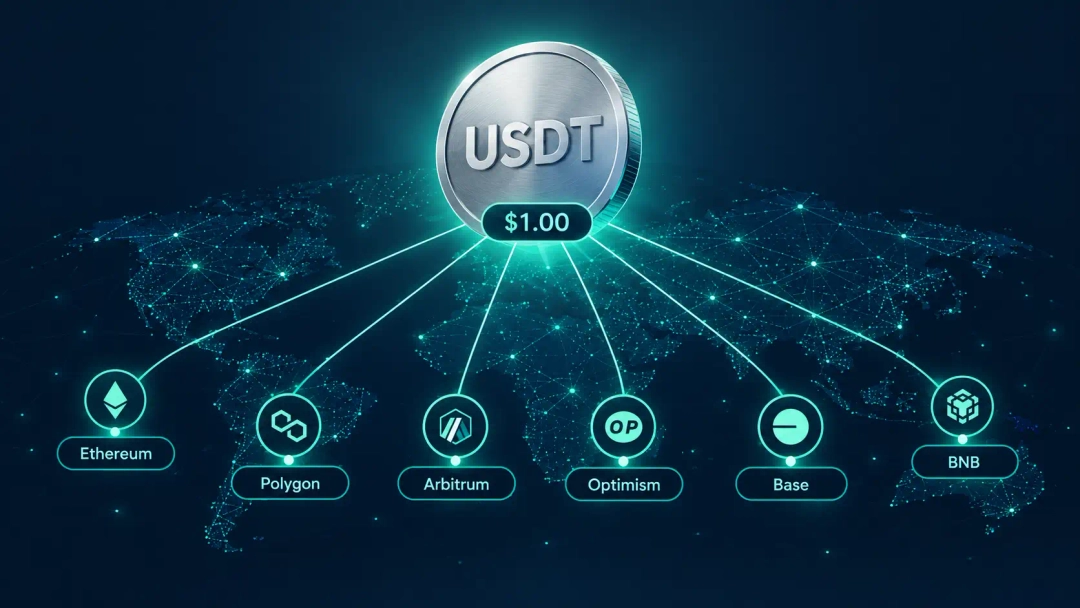
If USDT keeps showing up on trading pairs and P2P offers and you are not sure what it really is, here is the core of it. USDT is a stablecoin issued by Tether, designed to stay worth one US dollar. Tether says each token is backed by reserves it holds, and the same token can run on several blockchains. People use it to trade, to send money across borders, and to hold value without the price swings that come with Bitcoin.
This guide goes through what actually backs USDT in 2026, which network to use, and where the real risks are.
Educational content only, not financial advice. Figures last updated October 2026.
What is USDT in plain language?
USDT, also called Tether, is a cryptocurrency built to behave like a digital dollar. Unlike Bitcoin and Ethereum, it is designed to hold a stable value by being pegged to the US dollar. That makes it useful when you want to move value on a blockchain without taking on price risk.
Tether Limited issues it. The company is incorporated in the British Virgin Islands, and it launched the token in 2014. USDT does not have its own independent blockchain. It is a token that lives on other networks, such as Ethereum, Polygon, Solana, and Tron.
Because one company issues it, USDT is centralized. You are trusting Tether to hold the reserves it says it holds and to honor redemptions. Stability here comes at the cost of that trust.
How does USDT keep its $1 value?
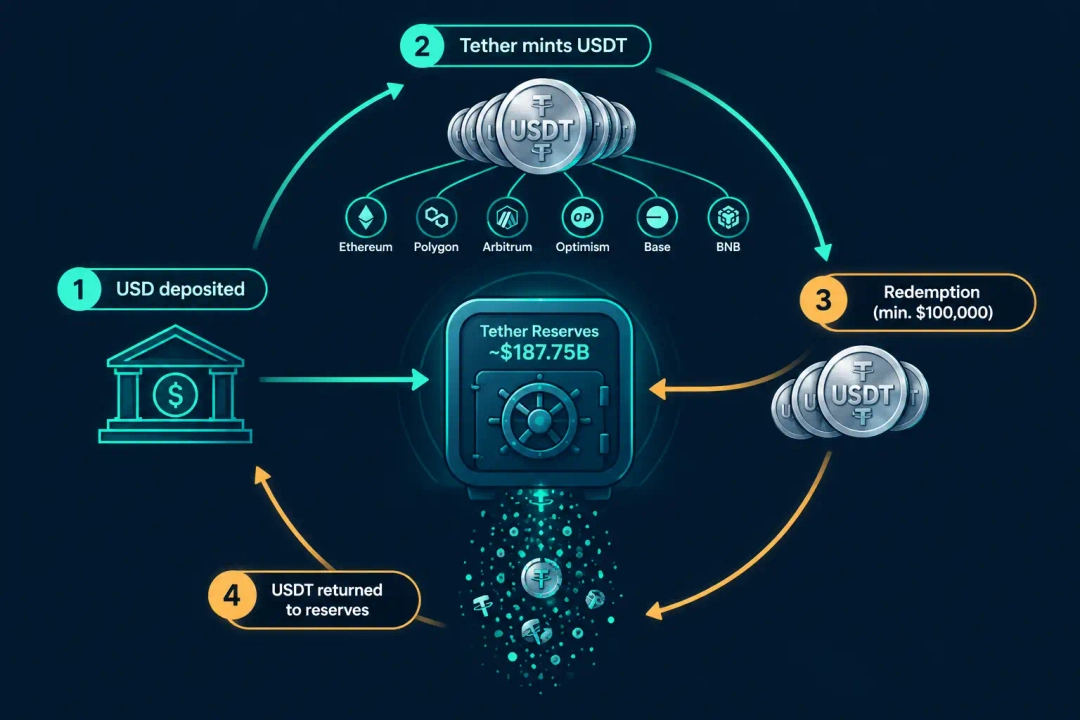
Three mechanisms keep USDT near a dollar: reserves, mint and burn, and arbitrage.
- Reserves. Tether says each USDT is backed by reserve assets, mostly short-term US government investments.
- Mint and burn. When users buy USDT, Tether issues new tokens. When they redeem for fiat, the matching tokens are destroyed. Supply is not fixed. It follows demand.
- Arbitrage. If USDT trades at $0.99 on an exchange, approved large traders can buy it cheaply and redeem it for $1, which pushes the price back up. The reverse happens above $1.
Redeeming directly with Tether requires account verification and minimum amounts of $100,000, so most people cash out through exchanges instead. Everyday users rely on the market price, not on Tether's redemption desk.
What backs USDT in 2026?
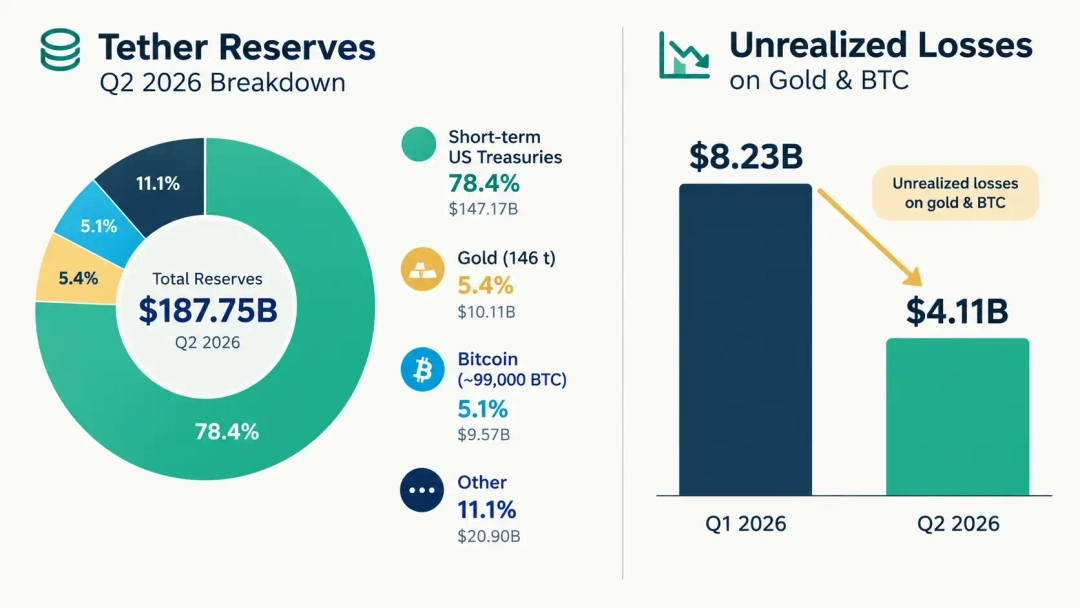
Tether publishes quarterly attestations, which are accountant-reviewed snapshots of its reserves. The Q2 2026 report, as of June 30, shows about $187.75 billion in assets against roughly $183.64 billion in liabilities, a surplus of about $4.11 billion. About $184.6 billion of USDT was in circulation.
Most of the backing sits in short-term US government investments, but not all of it. Tether also reported more than 146 metric tons of gold, and its Bitcoin holdings stood near 99,000 coins.
The surplus is the number to watch. It was $8.23 billion at the end of the first quarter and fell to $4.11 billion in Q2. Unrealized losses on gold and Bitcoin caused the drop. USDT remained fully backed on Tether's numbers, but the cushion shrank.
Item (June 30, 2026) | Figure |
Total assets | ~$187.75B |
Liabilities | ~$183.64B |
Surplus | ~$4.11B (down from ~$8.23B) |
USDT in circulation | ~$184.6B |
An attestation is not a full audit. It confirms figures at a point in time; an audit examines a company's financial statements and controls more deeply. Tether reportedly engaged a Big Four firm in March 2026 for its first full audit, so this picture may change. Check Tether's transparency page before you rely on any number here.
What is USDT used for?
- Trading. USDT is the base pair for thousands of crypto markets, so traders use it as a dollar stand-in between trades.
- Cross-border payments. Freelancers, importers, and families use it to move dollars quickly without relying on bank transfers.
- Protecting against local inflation. Where the local currency loses value fast, USDT works as an accessible digital dollar.
- P2P trading. People buy and sell USDT directly with each other for local currency, often through bank transfers or local payment apps.
Which network should you use for USDT?
The same USDT can exist on many networks, and the choice affects fees, speed, and who will accept it. Tron and Ethereum carry large amounts of USDT. On Polygon it is native, meaning it can be minted and redeemed there without relying on bridges.
Network | What to know |
Ethereum | Deepest liquidity and broadest support, but fees are usually the highest |
Polygon | Native USDT, generally low fees |
Arbitrum, Optimism, Base | Ethereum layer-2 networks with lower fees than Ethereum itself |
BNB Smart Chain | Low fees, widely used in the Binance ecosystem |
Senpero supports all of these: Ethereum, Polygon, Arbitrum, Optimism, Base, and BNB Smart Chain. Tron, popular for USDT transfers, is not among them.
Whatever chain you pick, the sender and receiver have to agree on it. USDT sent to the wrong network can be lost permanently. Send a small test transaction first, and check the token contract address on the network's block explorer rather than trusting a search result.
A quick example: moving USDT without losing it
Say a buyer in another country is sending you USDT. A safe routine:
- Agree on the network first. Both sides confirm "USDT on Base," not just "USDT."
- Copy the address from your own wallet. After pasting, compare the first and last characters.
- Send a small test amount and wait until it arrives.
- Send the rest, then confirm the transaction on the block explorer.
- Check the token contract against the official address Tether lists.
A few extra minutes here prevents the most common and least reversible mistake in crypto.
USDT vs USDC
USDC is USDT's main rival. Both aim to stay at one dollar, but they have different issuers, and USDT consistently has the higher market capitalization and trading volume. Which one suits you depends on where you live and what your platform supports. USDT remains the default quote currency in many markets, while some regulated venues now favor other stablecoins.
What are the risks of USDT?
USDT is far less volatile than Bitcoin, but it is not risk-free.
- Issuer risk. You depend on one company's reserves and honesty. The New York Attorney General fined Tether $41 million over misrepresenting its dollar backing, which is why current reporting matters.
- Reserve composition. Roughly one-quarter of USDT's backing is held in assets, including bitcoin, precious metals, and lending exposures, that would not meet the GENIUS Act's reserve standards.
- Regulation. USDT is absent from MiCA-licensed venues in the European Economic Area after Tether declined to seek authorization. In the US, the GENIUS Act, signed on July 18, 2025, gives foreign issuers until July 18, 2028 to comply, and federal agencies have not finalized the rules. Tether launched a separate US-compliant coin, USAT, so rules in your country may affect where you can buy, sell, or hold USDT.
- Depegging. Temporary loss of parity remains a risk. The price can briefly slip below $1 in stress, and a loss of confidence could make that worse.
- Freezing. Tether can technically freeze USDT at specific addresses, usually in response to law enforcement requests.
- Scams. Fake wallets, fake support, and wrong-network transfers cause more day-to-day losses than any depeg.
Holding USDT yourself vs. on an exchange
Where you keep USDT matters as much as which stablecoin you pick. On an exchange, the platform holds the keys. If it fails or freezes withdrawals, your balance is stuck. In a non-custodial wallet, you hold the keys, and no platform can lock your funds.
Senpero is a non-custodial P2P marketplace where you can buy and sell crypto from your own wallet, so you are not depositing funds with a platform first.
Self-custody solves platform risk, not issuer risk. A USDT balance in your own wallet still depends on Tether, and plenty of people accept that trade-off knowingly. A reasonable habit is to hold only what you need in USDT, keep recovery phrases offline, and start with small trades while you learn a new flow.
FAQ
Is USDT safe?
It is designed to hold $1 and has done so most of the time, but it carries issuer, reserve, regulatory, and depegging risks. Read Tether's latest attestation, and don't treat any stablecoin as cash in a bank.
Is USDT fully backed?
Tether's Q2 2026 attestation shows assets exceeding liabilities by about $4.11 billion. That is an attestation, not a full audit, and some reserves are in volatile assets.
What is the difference between USD and USDT?
USD is government-issued money. USDT is a private company's token meant to track it. Holding USDT does not give you a claim on a bank account.
Can I redeem USDT for dollars?
Directly with Tether, mostly large verified accounts can. Most people sell through an exchange or a P2P trade.
Which blockchains does USDT run on?
Many, including Ethereum, Tron, Solana, and Polygon. On Senpero you can use Ethereum, Polygon, Arbitrum, Optimism, Base, and BNB Smart Chain.
Is USDT legal?
It depends on your country. USDT is widely used, but some regions restrict it on regulated venues, including the EU under MiCA. Check local rules.
Conclusion
USDT is a dollar-pegged token from a single issuer. It gives you stable value and global liquidity at the cost of trusting Tether. Its 2026 reserve report shows full backing with a thinner cushion than a quarter earlier, and regulation in the EU and the US is reshaping where it can be used.
- USDT targets $1 but depends on Tether's reserves and redemption.
- Pick your network carefully; mismatched networks can lose funds.
- Self-custody protects you from platform risk, not issuer risk.
Ready to trade? Try buying or selling USDT peer-to-peer from your own wallet on Senpero. Only trade amounts you can afford to lose.

Ready to Trade?
Join thousands of traders on our secure P2P platform with smart contract protection.
Ready to trade? Set your own offer.
Join the P2P marketplace to buy or sell crypto on your terms.
Ready to Trade?
Start trading cryptocurrency instantly with peer-to-peer buyers and sellers using local payment methods.